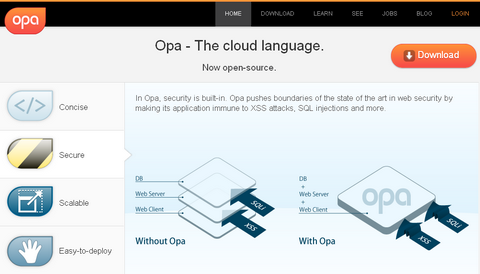
Opa is a new generation of web development platform. It is a new programming language, a new web server, a new database and a new distributed execution engine, all of them tightly integrated to provide a great experience for web developers.
Opa is concise, simple and readable, it is also extremely powerful, concurrent, dynamically distributed, and extremely secure, much more so than just about any other programming language. Opa is designed to make web development fun, secure and right.
Requirements: 64 bit platforms
Demo: http://opalang.org/
License: GPL License
Sprite Cow helps you get the background-position, width and height of sprites within a spritesheet as a nice bit of copyable css. I personally found it pretty useful and easy to use.
There are one or two rather clever tricks happening with Javascript and Canvas to discover the dimensions of images and generate the CSS, they have also shared the code on Github so that others can see under the hood.

Requirements: –
Demo: http://www.spritecow.com/
License: MIT, GPL License
Vegas Background jQuery plugin lets you add beautiful fullscreen backgrounds to your webpages. It even allows Slideshows. Slideshows of different backgrounds, transition and callbacks can be easily set up.
Most of the time, backgrounds are stretched a lot to fit big screens. An overlay with a texture can be added to mask the image degradation effects. It also adds a stylish look to your backgrounds. You can easily add overlay pattern to your backgrounds with CSS.

Requirements: jQuery Framework
Demo: http://vegas.jaysalvat.com//
License: MIT, GPL License
DepthJS allows any web page to interact with the Microsoft Kinect using Javascript. Navigating the web is only one application of the framework they built – that is, they envision all sorts of applications that run in the browser, from games to specific utilities for specific sites.
The great part is that now web developers who specialize in Javascript can work with the Kinect without having to learn any special languages or code. DepthJS is open source under the AGPL license.

Requirements: Javascript Framework
Demo: http://depthjs.media.mit.edu/
License: AGPL License
Speakker is a crossbrowser Audio solution featuring HTML5. It comes out of the box in two variations and with incredible options of customization: Flexible dimensions, unlimited colors and two different button sets for light and dark themes. Easy to set up. Just a few lines of Javascript and a quantum CSS.

You can also check out HTML5 Music Portfolio Template with jQuery. The idea is to create an artist portfolio with a discography line up and HTML5 audio player jPlayer. The artist albums are shown using the jCarousel plugin and the user can add song samples to the play list and reorder the songs by dragging them.

Requirements: jQuery Framework
Demo: http://www.speakker.com/demo/
License: GPL License
Demo: http://tympanus.net/Development/MusicPortfolioTemplate/
License: License Free
Mosaic jQuery Plugin automatically generates sliding boxes & captions. It allows slide & fade animations with custom directions. It preloads images within boxes. It is very lightweight at ~2kb (minified).
Implementation is fairly easy, they have provided a number of sample configurations in the downloadable file. It operates with two panels – an overlay and a backdrop. The content in the overlay gets repositioned according to the options that you provide.

Requirements: jQuery Framework
Demo: http://buildinternet.com/project/mosaic/
License: MIT, GPL License
TeamLab is a free open-source platform for business collaboration and project management. It allows you to use social networking tools such as blogs and forums, organize business tasks and milestones, as well as communicate with your team members via corporate IM.
TeamLab business collaboration platform is an open-source software. The source code is for developers and experienced users who wish to install and configure the platform manually on their own server. According to the license terms, you are free to test, evaluate, customize and improve the code.

Requirements: –
Demo: http://www.teamlab.com/
License: GPL License
Zoomy is a quick and easy plugin that will zoom into a picture. You only need two images; the display image and the zoomed in image. Just link the zoomed in picture on the display picture, and tell the plugin to use that link when zooming.
Zoomy is easy to implement and customize. There are a few options that allow you to change the appearance and usability of Zoomy. Plug it in, and even the most boring pictures can turn heads. Get a extra level of detail without boging down your page with gaint images. Take it for a test drive, and let Zoomy magnify you website.

Requirements: jQuery Framework
Demo: http://redeyeoperations.com/plugins/zoomy/
License: MIT, GPL License
In 2009, the White House chosen Drupal as the open source platform for its web site. If the most powerful voice in our nation chooses to tap into global innovation by using an economical, open source platform called Drupal to manage intensely scrutinized, mission-critical content each day and to effectively encourage feedback from citizens … why wouldn’t you?
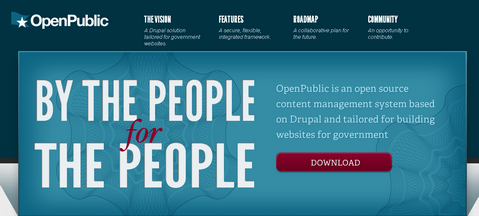
OpenPublic is the product of a decade’s work in the open source network and the collective experience of building secure, scalable, transparent websites for all sectors of government and the citizens they serve.
Requirements: Drupal Framework
Demo: http://www.openpublicapp.com
License: GPL License
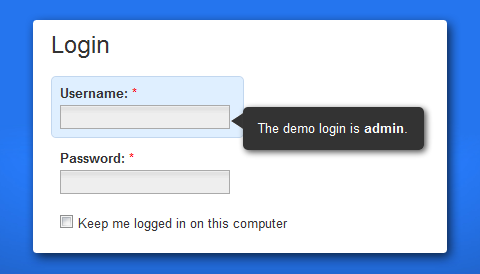
jFormer is a form framework written on top of jQuery that allows you to quickly generate beautiful, standards compliant forms. Leveraging the latest techniques in web design, jFormer helps you create web forms that: Validate client-side, Validate server-side, Process without changing pages (using AJAX).
At 18K gzipped, jFormer is one of the first frameworks that comes Closure Compiled with Google’s latest JavaScript compression technology. You may use any jFormer project under the terms of either the MIT License or the GNU General Public License (GPL) Version 2.
Requirements: jQuery Framework
Demo: http://www.jformer.com/
License: MIT , GPL License