Outline is a simple CSS starter responsive boilerplate for any new web project, created by Matt Harris. It’s a modular, mobile-first framework which includes todays best practices for responsive design and core components I use on every project. Outline is designed to be a starting point. A solid foundation for your project, leaving the creativity up to you.

Requirements: –
Demo: http://www.outlinecss.co.uk/
License: MIT License
Dynamics.js is a JavaScript library to create physics-based animations. Simply include dynamics.js into your page, and then you can animate CSS properties of any DOM element. You also can animate SVG properties. Dynamics.js has its own setTimeout. The reason is that requestAnimationFrame and setTimeout have different behaviors. And any JavaScript object. It has been tested on Safari 7+, Firefox 35+, Chrome 34+, IE10+.

Requirements: javaScript Framework
Demo: http://dynamicsjs.com/
License: MIT License
The delay between HTTP objects being requested/recieved leaves a timeframe where a webpage can look incomplete. Inspired by Soundclouds’s use of random gradients, Gradify can analyse an image for the 4 most common colors and create a gradient (or solid color) to act as a placeholder image. Gradify is a module which finds the most prominent colors in any image, and produces a scalable, responsive CSS gradient. This can provide a less jarring experience as image placeholders.

Requirements: –
Demo: http://gradifycss.com/
License: MIT License
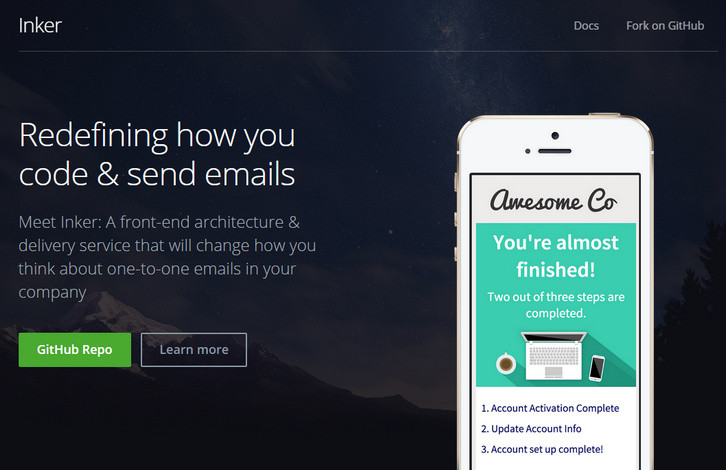
Inker is an open source front-end architecture & delivery service that will change how you think about one-to-one emails in your company. Inker takes you from coding to sending, keeping it centralized
so that your team stops losing time over emails & can focus on more important things.
Inker keeps your email code clean & gives you the tools to test faster. Free templates for transactional emails (forgot password, receipts, account creation). Inker uses Zurb Ink to provide you with a superior responsive CSS framework: you get all the goodies + a Sass component oriented structure.
Requirements: –
Demo: http://inker.position-absolute.com/
License: MIT License
Rocket.Chat is a Web Chat Server, developed in JavaScript, using the Meteor fullstack framework. It is a great solution for communities and companies wanting to privately host their own chat service or for developers looking forward to build and evolve their own chat platforms. You can own an open source Slack-like chat. Note that Rocket.Chat is distributed under the MIT License.

Requirements: Meteor Framework
Demo: http://rocket.chat/
License: MIT License
Tabio is a Chrome extension designed to make managing lots of browser tabs significantly easier. The search feature allows you to quickly and easily find the tab you’re looking for. Tabio makes it easy to organize your tabs. Simply drag and drop to reorder. You can also use the enter, delete and arrow keys to navigate your tabs without leaving the keyboard. Best of all, Tabio is open source.

Requirements: –
Demo: http://colebemis.github.io/tabio/
License: MIT License
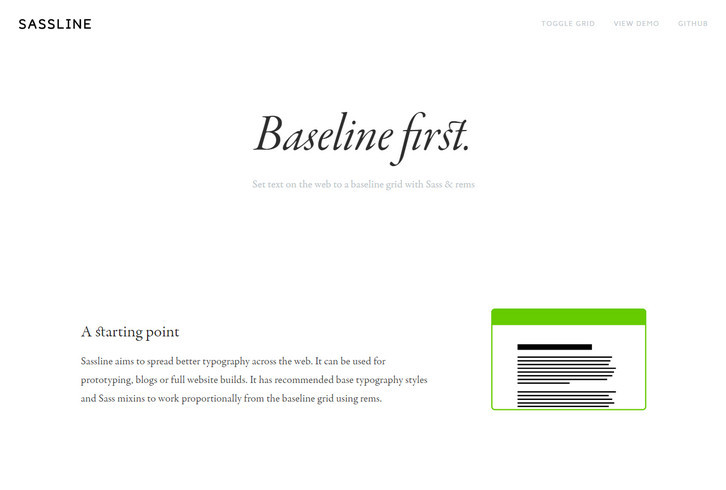
Sassline sets text on the web to a baseline grid with Sass & rems using a responsive modular-scale. Sassline aims to spread better typography across the web. It can be used for prototyping, blogs or full website builds. It has recommended base typography styles and Sass mixins to work proportionally from the baseline grid using rems.
Due to the way CSS handles text setting a baseline grid on the web is tricky. Sassline does all the heavy lifting and gives you near print level typographic control. Easily align text across columns and use a precise vertical rhythm based on the baseline grid. Sassline lets you set a modular-scale for each of your breakpoints and easily work from these values to size your type. This combined with the baseline grid allows you to have harmonious proportions across all aspects of your website.
Requirements: –
Demo: https://sassline.com/
License: MIT License
Let’s Chat is like #Slack, but opensource and self-hosted. It is a persistent messaging application that runs on Node.js and MongoDB. It’s designed to be easily deployable and fits well with small, intimate teams. It’s free (MIT licensed) and ships with killer features such as LDAP/Kerberos authentication, a REST-like API and XMPP support.

Requirements: –
Demo: https://sdelements.github.io/lets-chat/
License: MIT License
LastAutoIndex is a completely customizable auto index, and is designed to replace Apache’s pre-installed auto index. Installation is very simple, in your server root .htaccess, just disable Apache’s default indexer, and a add LastAutoIndex as a directory index. You can also customize the theme, checkout the src/public/themes directory.

Requirements: –
Demo: https://github.com/Project-CleverWeb/LastAutoIndex
License: MIT License
Challenger is a drop-in JavaScript library that adds interactive programming challenges to any page. Challenges are flexible and expressive, and are super simple to write. A challenge has requirements based on code structure and program output, and gives users a code editor to experiment in. When new code is written, it’s run in a sandbox and the output is analyzed. Challenges can be presented as one-off tests or linked together to form courses.

Requirements: JavaScript Framework
Demo: http://rileyjshaw.com/challenger/
License: MIT License