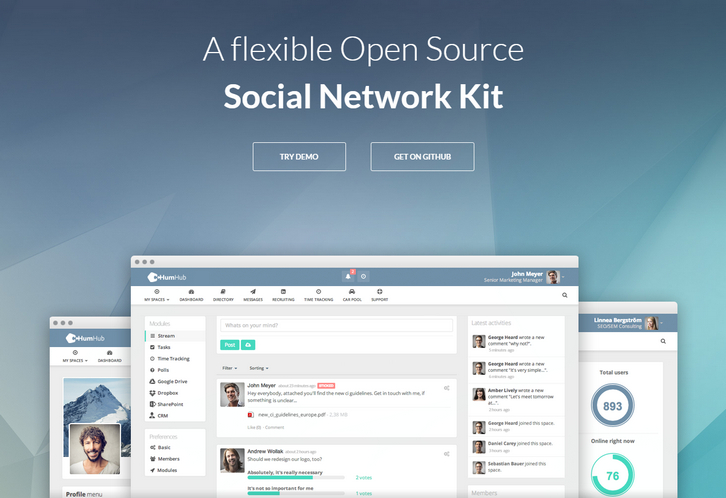
HumHub is a free social network software and framework built to give you the tools to make teamwork easy and successful. It’s lightweight, powerful and comes with an user-friendly interface. With HumHub you can create your own customized social network, social intranet or huge social enterprise application that really fits your needs.
HumHub is completely open- source. With a powerful module system you can extend HumHub by using third party tools, writing your own or connect existing software. Your server, your data, your rules. HumHub is a self- hosted solution and runs on almost every server. You are in the full control of your data.
Requirements: –
Demo: https://www.humhub.org/
License: AGPL v3 License
Cylon.js is a JavaScript framework for robotics and physical computing built on top of Node.js. It provides a simple, but powerful way to create solutions that incorporate multiple, different hardware devices concurrently. Cylon uses the Gort Command Line Interface (CLI) so you can access important features right from the command line. You can scan, connect, update device firmware, and more. Cylon also has its own CLI to generate new robots, adaptors, and drivers.
Requirements: JavaScript Framework
Demo: http://cylonjs.com/
License: Apache License
The Play Framework combines productivity and performance making it easy to build scalable web applications with Java and Scala. It’s built on Akka, Play provides predictable and minimal resource consumption (CPU, memory, threads) for highly-scalable applications.
Play is developer friendly with a “just hit refresh” workflow and built-in testing support. With Play, applications scale predictably due to a stateless and non-blocking architecture. By being RESTful by default, including assets compilers, JSON & WebSocket support, Play is a perfect fit for modern web & mobile applications.
Requirements: –
Demo: https://www.playframework.com/
License: Apache 2.0 License
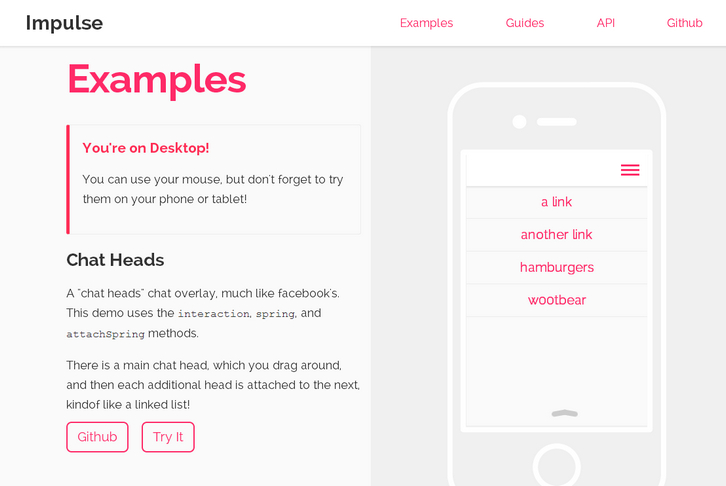
Impulse is a library for building dynamic physics based interactions, with a focus on mobile web. You can create animations that flow naturally from the user’s movements. Rather than animating properties for a set amount of time, impulse takes a start position, end position, and velocity.
Impulse is small, weighing in at about 9k minified and gziped. Impulse has no large dependencies. It doesn’t require jquery, but it knows how to work with jquery. Animations flow smoothly from user interactions. When a user swipes an element, it moves at the velocity of their swipe.
Requirements: JavaScript Framework
Demo: http://impulse.luster.io/
License: MIT License
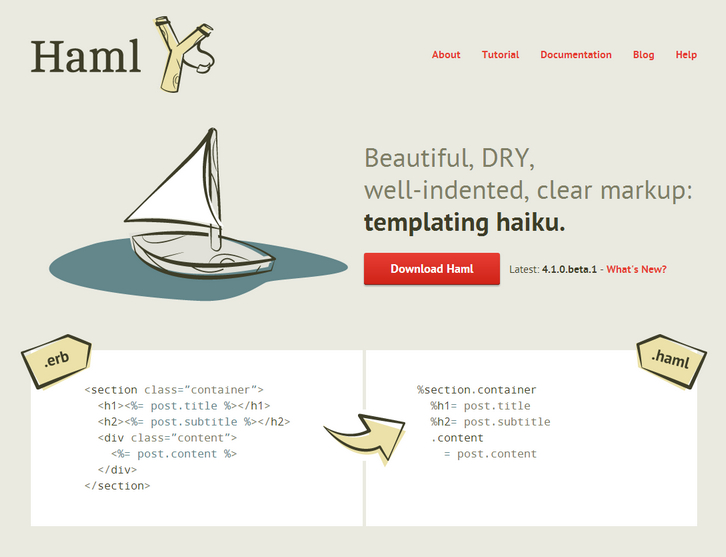
Haml (HTML abstraction markup language) is a markup language that’s used to cleanly and simply describe the HTML of any web document without the use of inline code. Haml functions as a replacement for inline page templating systems such as PHP, ASP, and ERB, the templating language used in most Ruby on Rails applications. However, Haml avoids the need for explicitly coding HTML into the template, because it itself is a description of the HTML, with some code to generate dynamic content.
Requirements: –
Demo: http://haml.info/
License: MIT License
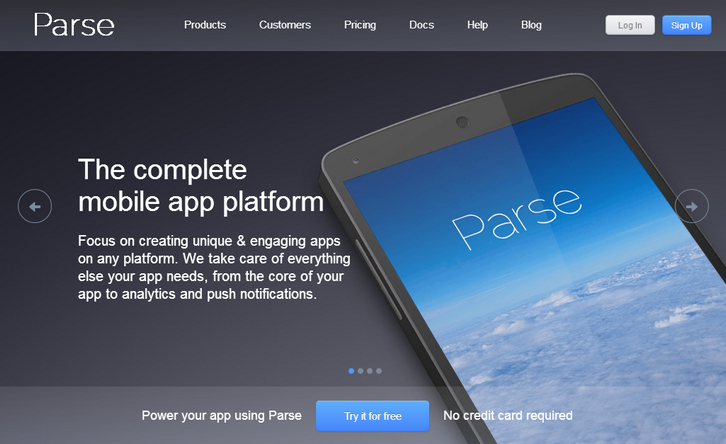
Parse is a complete mobile app platform that focuses on creating unique & engaging apps on any platform. We take care of everything else your app needs, from the core of your app to analytics and push notifications.
You can instantly add a powerful core, push notifications, and analytics to your app with Parse. With native SDKs for Android, iOS, JavaScript, Unity, and more, Parse has an SDK for everyone, whether you’re creating a desktop or mobile app.
Requirements: JavaScript Framework
Demo: https://parse.com/
License: Terms of Use
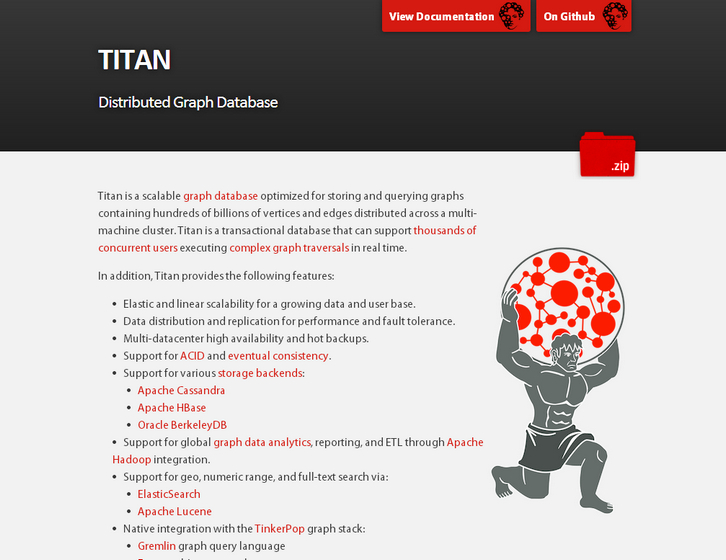
Titan is a scalable graph database optimized for storing and querying graphs containing hundreds of billions of vertices and edges distributed across a multi-machine cluster. Titan is a transactional database that can support thousands of concurrent users executing complex graph traversals in real time.
Requirements: –
Demo: http://thinkaurelius.github.io/titan/
License: Apache 2.0 License
Duo is a next-generation package manager that blends the best ideas from Component, Browserify and Go to make organizing and writing front-end code quick and painless. Duo was designed from the ground up to grow alongside your application, making your three main workflows incredibly simple: Creating quick proof of concepts, writing modular components, building large web applications.
Requirements: JavaScript Framework
Demo: http://duojs.org/
License: MIT License
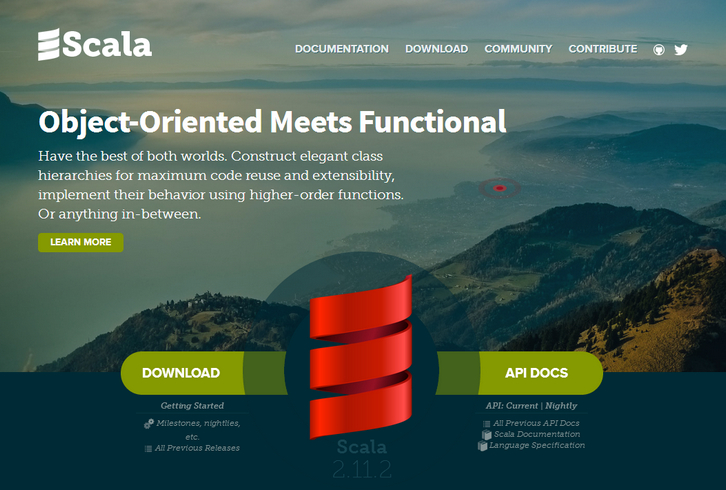
Scala is an acronym for “Scalable Language”. This means that Scala grows with you. You can play with it by typing one-line expressions and observing the results. But you can also rely on it for large mission critical systems, as many companies, including Twitter, LinkedIn, or Intel do.
Scala is a pure-bred object-oriented language. Conceptually, every value is an object and every operation is a method-call. The language supports advanced component architectures through classes and traits.
Scala’s approach is to develop a small set of core constructs that can be combined in flexible ways. This applies also to its object-oriented and functional natures. Features from both sides are unified to a degree where Functional and Object-oriented can be seen as two sides of the same coin.
Requirements: –
Demo: http://www.scala-lang.org/
License: BSD License
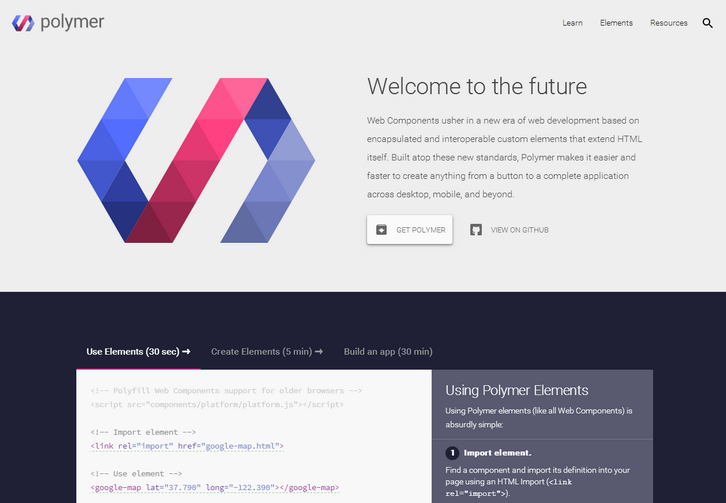
Web Components usher in a new era of web development based on encapsulated and interoperable custom elements that extend HTML itself. Built atop these new standards, Polymer makes it easier and faster to create anything from a button to a complete application across desktop, mobile, and beyond.
Polymer brings an implementation of material design to the web. The paper elements range from controls to effects and user interaction. Designer is a drag and drop tool for prototyping apps using Polymer. You can save your experiments as Github gists.
Requirements: –
Demo: http://www.polymer-project.org/
License: BSD License